
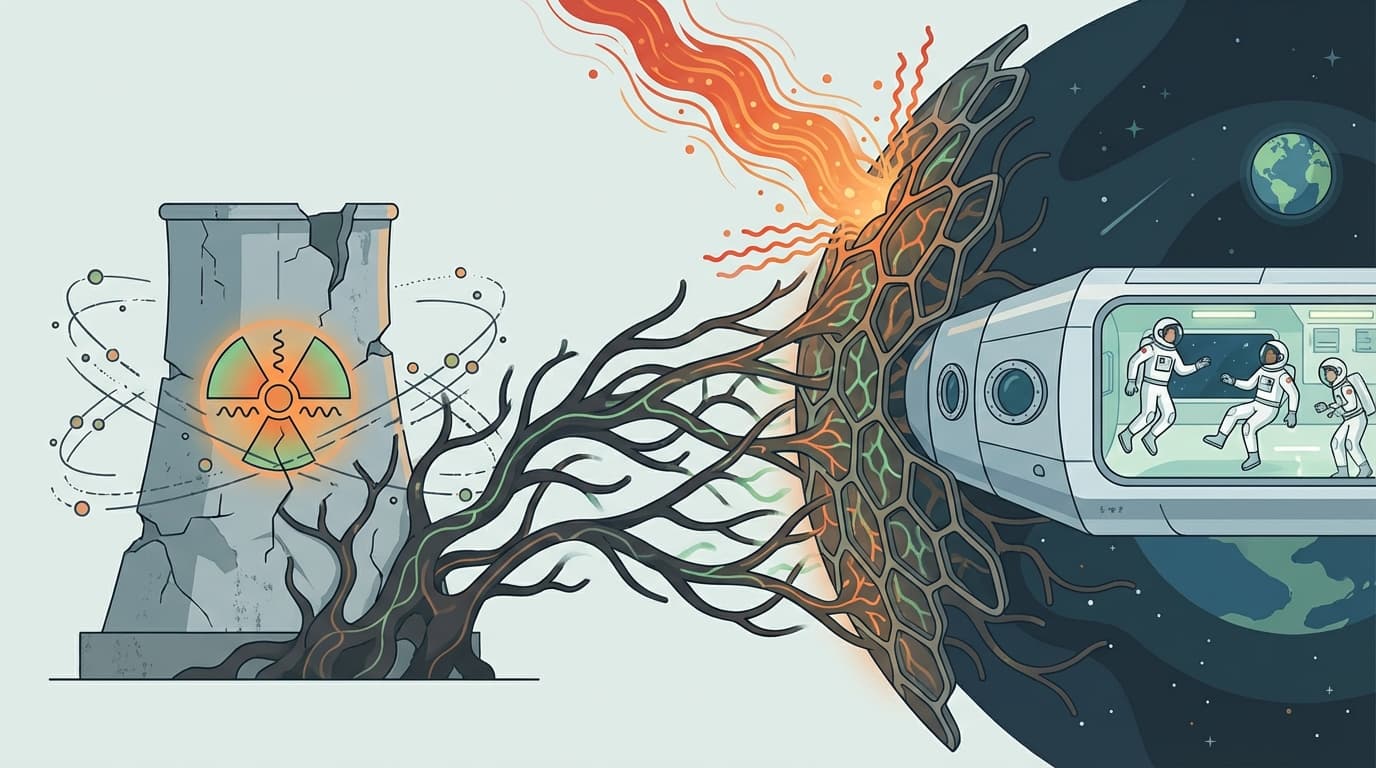
Seldom has a scientific discovery so fundamentally challenged assumptions about the limits of biological survival. Following the catastrophic 1986 Chernobyl nuclear disaster, researchers anticipated finding a lifeless exclusion zone. Instead, they encountered organisms not merely surviving but actively thriving amid lethal radiation levels. Among these was Cladosporium sphaerospermum, a common black fungus exhibiting an extraordinary adaptive trait. It demonstrated positive radiotropism, meaning it grew deliberately toward the highest concentrations of radiation.
What distinguishes this organism from conventional life forms is its remarkable capacity to harness ionizing radiation. The fungus is rich in melanin, the same pigment that shields human skin from ultraviolet light. Scientists believe melanin enables the fungus to absorb radiative energy and neutralize the resulting chemical damage. To investigate its potential applications, researchers sent samples to the International Space Station in a specially designed module. This autonomous CubeLab was equipped with Raspberry Pi computers, cameras, and sensors monitoring temperature, humidity, and radiation.
The experimental protocol was meticulously designed to yield reliable comparative data. The fungus was grown in a split Petri dish, with one side containing the organism and the other serving as a negative control. Kept at four degrees Celsius during transit, the samples remained dormant until reaching the station. The experiment then ran for over 622 hours at approximately 31.5 degrees Celsius. Photographs were captured every thirty minutes, while radiation readings were logged every ninety seconds.
The results, published in the peer-reviewed journal Frontiers in Microbiology, proved both compelling and cautiously optimistic. The fungus grew approximately 21 percent faster in orbit than identical samples cultivated on Earth. Furthermore, radiation sensors beneath the fungal colony recorded 147 counts per minute, compared with 151 beneath the control side. This gap widened progressively as the fungal layer grew thicker, suggesting measurable shielding properties. Nevertheless, the researchers employed deliberately cautious language regarding definitive conclusions about radiation protection.
The broader implications of this research align with the concept of In-Situ Resource Utilization in space exploration. Traditional radiation shielding imposes a substantial weight tax, as every additional kilogram launched into orbit incurs significant cost. A self-replicating biological shield, grown from a small initial sample, could theoretically circumvent this logistical constraint entirely. Moreover, living biomass contains abundant water, and hydrogen within water effectively slows energetic protons and neutrons. Should further research validate these preliminary findings, this humble fungus may prove indispensable for future deep-space missions.