
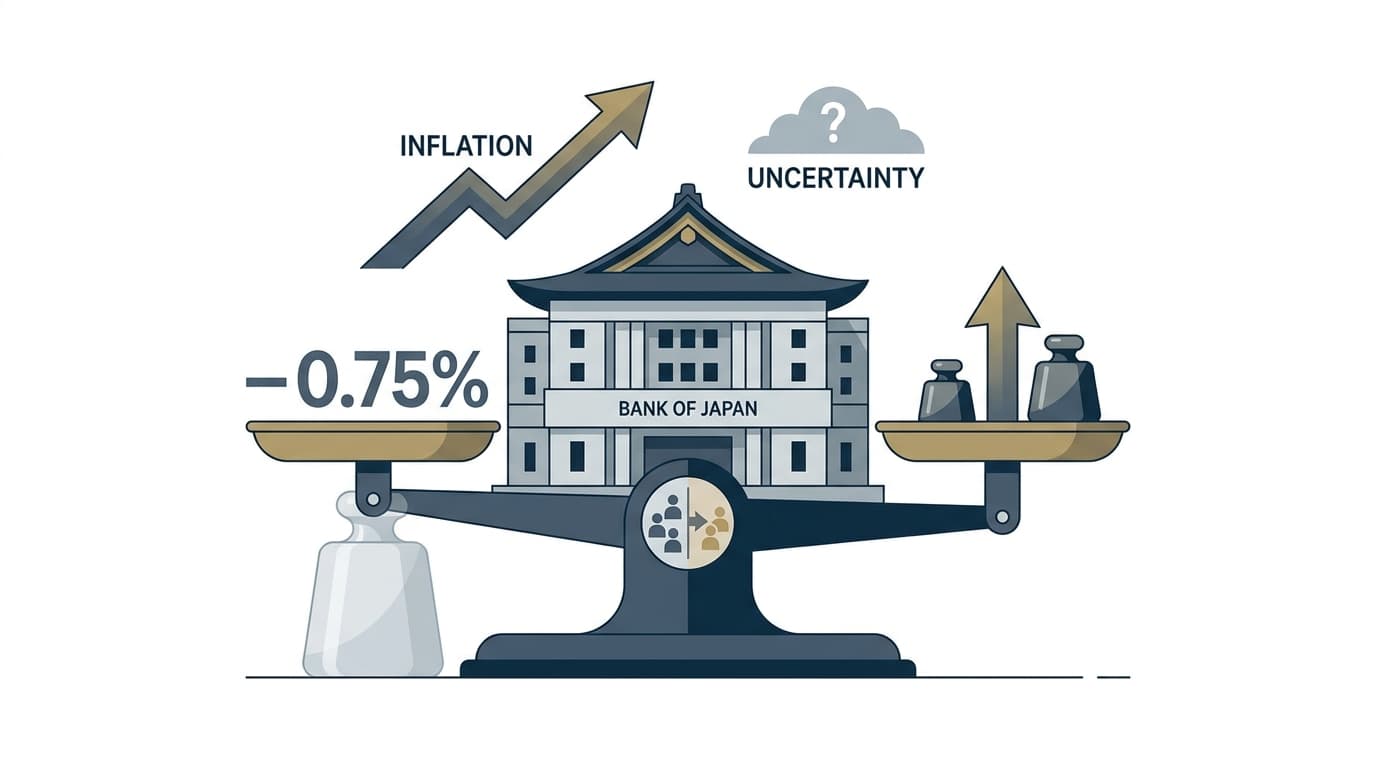
The Bank of Japan held its short-term policy rate at 0.75% on Tuesday. The decision came after a two-day monetary policy meeting in Tokyo. However, the vote was notably divided, with a 6-3 split among board members. Three dissenting members had advocated for raising the rate to 1.0%. This level of disagreement is unusual and signals growing tension within the central bank.
The board simultaneously upgraded its inflation outlook in a significant revision. The core consumer price forecast for fiscal 2026 was raised to 2.8% from 1.9%. Rising crude oil prices, driven by the ongoing Middle East conflict, were cited as the primary factor. Meanwhile, the growth forecast for fiscal 2026 was cut to just 0.5% from 1.0%. This combination of higher inflation and slower growth presents a classic stagflationary challenge.
Dissenting members Takata, Tamura, and Nakagawa argued that price risks were skewed upward. They believed that accommodative financial conditions could allow inflation to accelerate further. Nakagawa's dissent particularly surprised markets, as she had been considered relatively dovish. Analysts now widely interpret the decision as a hawkish hold rather than a genuine pause. Many expect the next rate hike could come as early as June.
Governor Kazuo Ueda is expected to clarify the bank's policy direction at his press conference. Real interest rates in Japan remain at significantly low levels by the board's own assessment. The yen strengthened modestly after the announcement, reflecting the hawkish undertone of the decision. For global investors, the BOJ's cautious stance underscores how geopolitical uncertainty can constrain monetary policy. The path toward normalization remains intact, but the pace will depend on evolving conditions.