
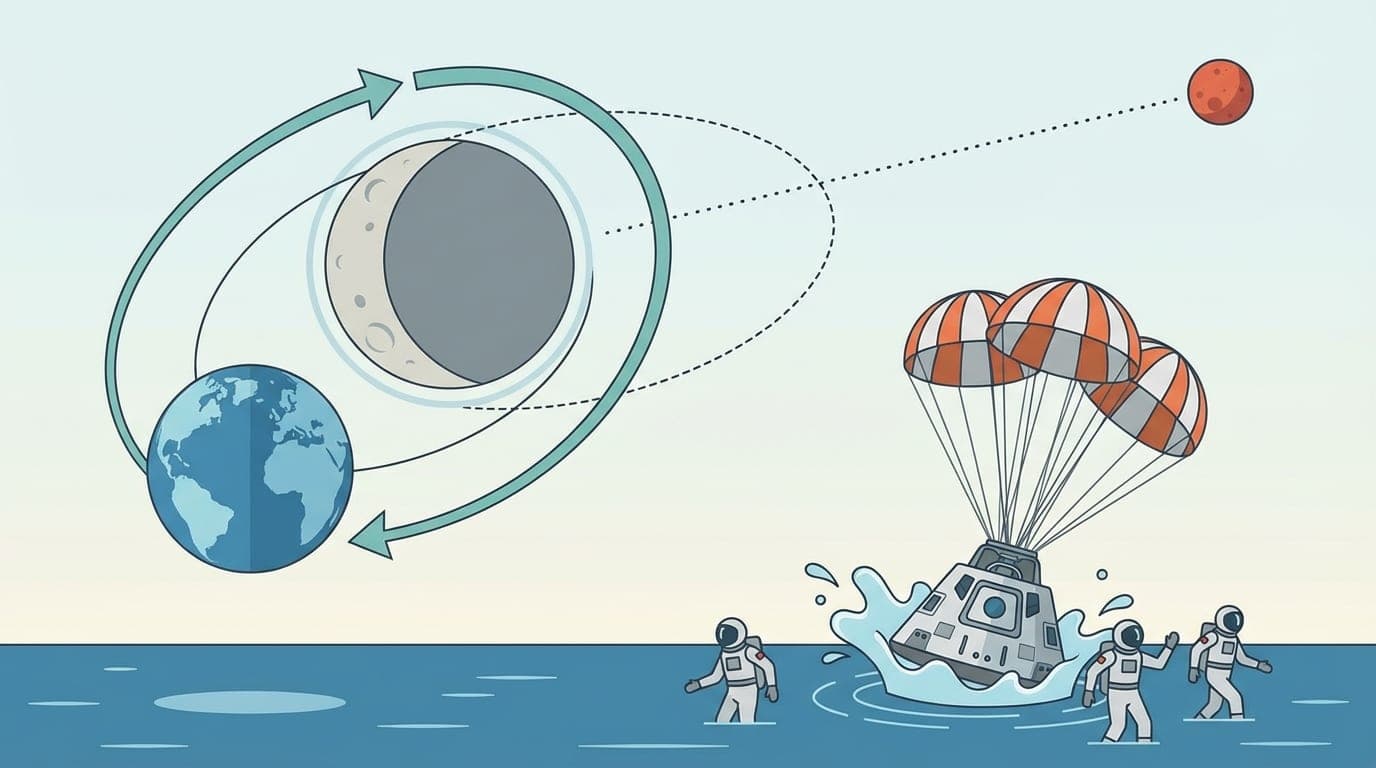
The four astronauts of NASA's Artemis II mission received a triumphant welcome after their unprecedented journey around the Moon. Commander Reid Wiseman, pilot Victor Glover, and mission specialists Christina Koch and Jeremy Hansen splashed down safely on April 10, 2026. Their Orion spacecraft landed in the Pacific Ocean off the coast of San Diego, California. The crew had traveled a remarkable 694,481 miles during the ten-day mission. This achievement represents a significant milestone in humanity's renewed pursuit of deep-space exploration.
During the mission, the astronauts surpassed the distance record previously held by the Apollo 13 crew since 1970. At their farthest point, they ventured 252,756 miles from Earth. The crew also observed parts of the lunar surface that no human had ever witnessed before. They described features such as the ancient Orientale basin in intricate detail to scientists on Earth. This basin, which is nearly 600 miles wide, had never been seen in its entirety by human eyes.
The splashdown concluded a meticulously planned recovery operation involving NASA and the United States military. Navy divers extracted the crew and transported them by helicopter to the USS John P. Murtha. The astronauts subsequently flew to Ellington Field near NASA's Johnson Space Center in Houston. Hundreds of colleagues and supporters gathered there to welcome them home with a standing ovation. NASA Associate Administrator Amit Kshatriya praised the mission as a pivotal step toward future lunar landings.
Artemis II was primarily a test flight designed to evaluate the Orion spacecraft's systems in deep space. Had this mission not succeeded, NASA's broader plans for returning humans to the lunar surface would have been jeopardized. The space agency is already preparing for Artemis III, which is expected to launch in 2027. That subsequent mission will involve practicing orbital docking procedures essential for landing on the Moon. The implications of Artemis II extend far beyond a single voyage, as it has laid the groundwork for sustained exploration.