
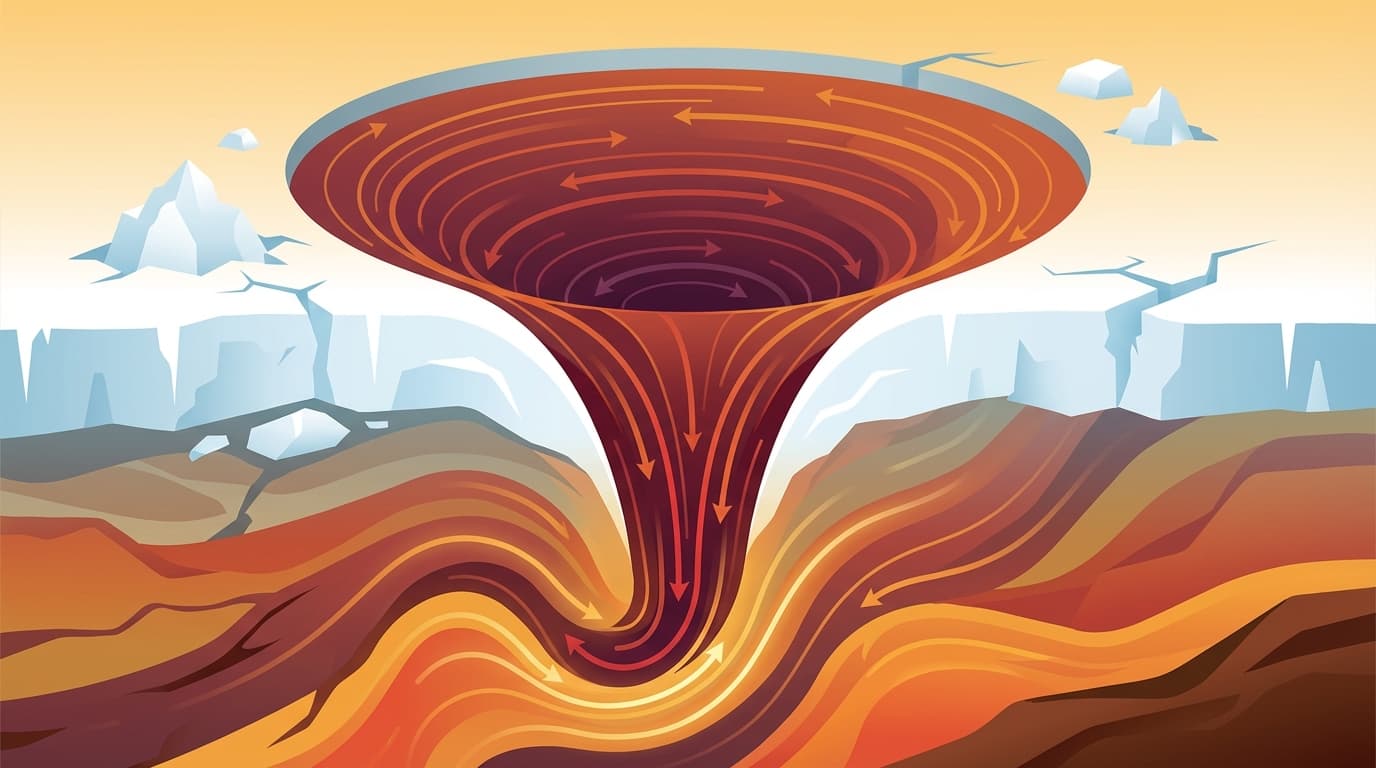
Beneath Antarctica, there is a region where Earth's gravitational pull is weaker than average. Scientists call this unusual area a "gravity hole." A recent study published in Scientific Reports has revealed something surprising about it. This gravity hole has been quietly growing stronger over millions of years. Researchers are now trying to understand what this means for our planet's future.
The study found that the gravity hole intensified between 50 and 30 million years ago. This period coincided with the beginning of widespread glaciation across Antarctica. Cold, dense material had sunk deep into the Earth's mantle during that time. Simultaneously, hotter and lighter material began rising from below. This combination amplified the deficit of mass beneath the continent.
To investigate this phenomenon, researchers reconstructed the Earth's interior using global earthquake recordings. Alessandro Forte, a geophysicist at the University of Florida, compared their method to a CT scan. He explained that earthquake waves provide the "light" that illuminates the planet's interior. The team used seismic and geodynamic data to simulate changes spanning 70 million years. Their work helps explain how Earth's uneven gravity shapes ocean surface levels worldwide.
The Earth's ocean surface, known as the geoid, is bumpy and irregular. Water naturally flows toward areas of stronger gravitational pull. Consequently, sea levels near Antarctica are typically lower than scientists would otherwise expect. Forte emphasized that understanding interior gravity could offer insight into ice sheet stability. Nevertheless, the team admits they cannot yet predict how climate change might affect this phenomenon.