
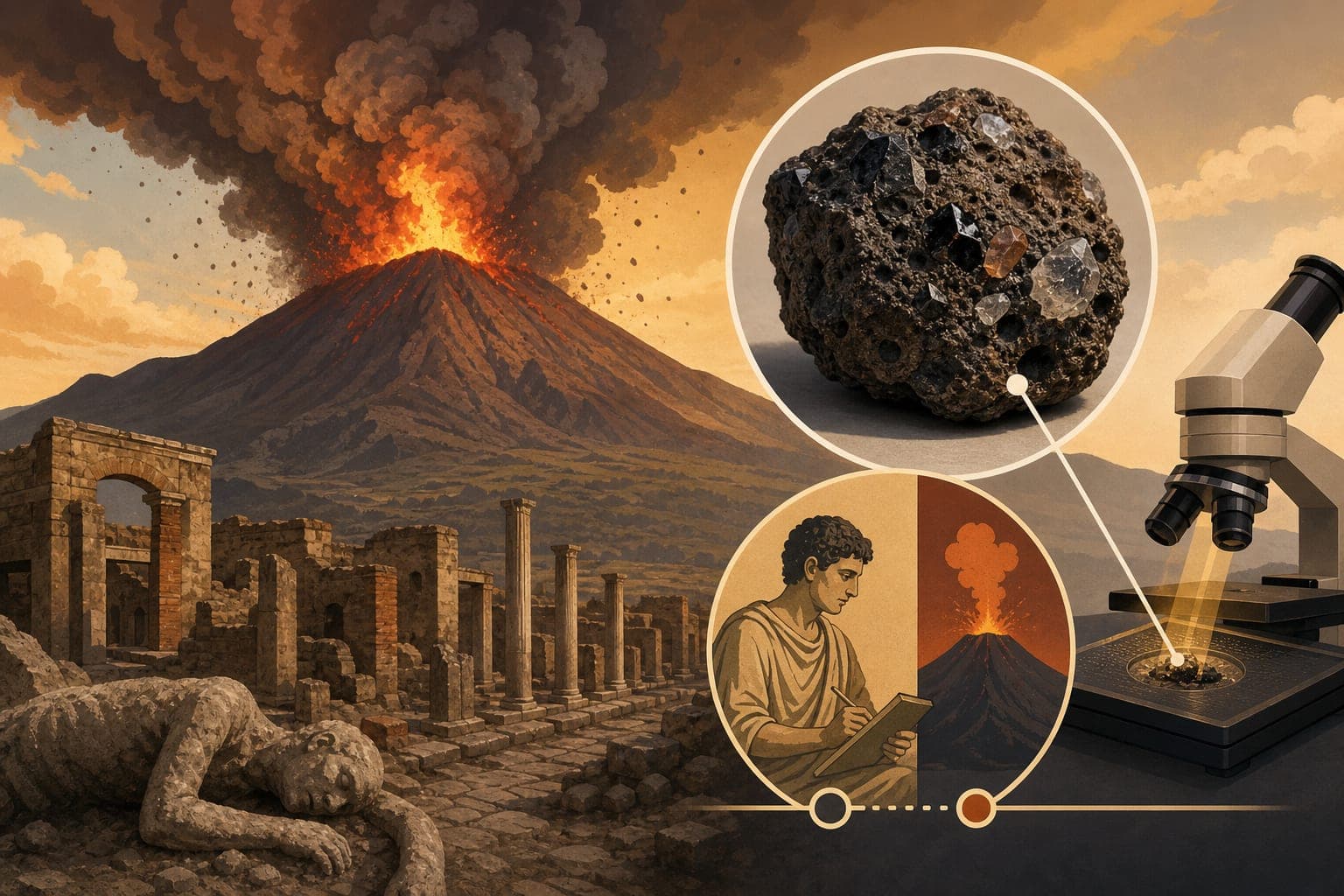
Seldom has a nearly two-thousand-year-old disaster proven so useful to modern science. A team of researchers has used volcanic rocks from Mount Vesuvius to test a refined dating method. Their result matched the historically recorded eruption date with striking accuracy. The study, published in Science Advances, demonstrates how ancient catastrophes can sharpen our understanding of geological time.
The technique, known as argon-argon dating, works like a clock embedded inside certain minerals. Potassium-40 in volcanic rock gradually decays into argon-40 at a known rate. Inside hot magma, argon escapes as gas. However, once the eruption occurs and minerals cool, argon becomes trapped and begins to accumulate.
Researchers examined eight samples of sanidine, a potassium-rich mineral, extracted from pumice near Pompeii. Their measurements placed the eruption at 1,938 years before the 2025 analysis, with an uncertainty of just 13 years. The historically inferred age, based on Pliny the Younger's eyewitness account, was 1,946 years. That gap represents a precision of 0.7 percent and an accuracy of 0.4 percent.
Pliny the Younger witnessed the catastrophe from a distance and documented it in remarkable detail. His account has long been treated as a benchmark for the eruption date of August 24, 79 CE. Some historians have contested this date, citing a coin found at Pompeii that may suggest a later timeframe. Nevertheless, the research team confirmed the traditional date remains the most reliable reference point.
The implications of this recalibrated method extend well beyond Pompeii. It could help scientists date eruptions from volcanoes that still threaten densely populated cities worldwide. Furthermore, the improved calibration may strengthen other techniques, including carbon-14 and uranium-lead dating. Had such precision been available earlier, our understanding of Earth's geological timeline would already be far richer.