
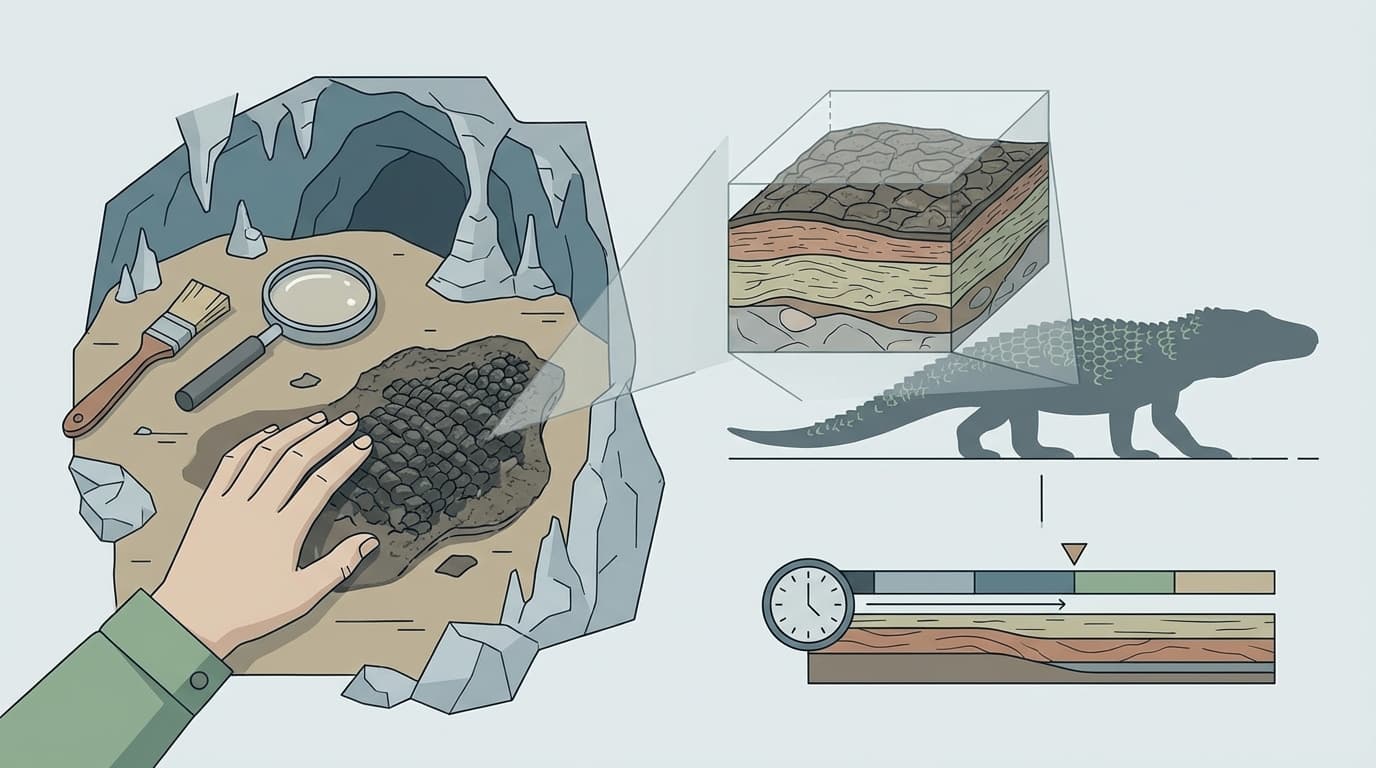
A team of paleontologists from the University of Toronto has made a groundbreaking discovery. They unearthed the oldest known fossilized reptile skin inside a cave in Oklahoma. The specimen, which had been preserved for approximately 289 million years, predates the dinosaurs. This extraordinary find was published in the scientific journal Current Biology. It offers unprecedented insight into how early reptiles adapted to terrestrial life.
The fossilized skin fragment was found in the Richards Spur limestone cave system. It is no larger than a fingernail and as thin as a human hair. Under microscopic examination, researchers identified scales and wrinkles resembling modern crocodile skin. The fossil includes both the outer epidermis and the rarely preserved inner dermis layer. Bands of folded scales separated by flexible hinge regions were also observed.
The exceptional preservation resulted from the cave's unique environmental conditions. Sticky hydrocarbons had seeped into the cave sediment, creating a protective coating around remains. These oil-based substances, combined with low oxygen levels, significantly slowed decomposition. Without such conditions, soft tissue like skin would have decayed rapidly after death. Researchers believe the skin most likely belonged to Captorhinus aguti, a small lizard-like reptile.
This discovery addresses a longstanding gap in paleontological research about early land animals. The fossil suggests that the complex structure of reptile scales has remained virtually unchanged. Developing tough, waterproof skin was essential for vertebrates transitioning from water to land. Had this skin not been preserved in such rare conditions, scientists would have lacked crucial evidence. Future studies will attempt to connect the skin fragment to a complete skeleton.