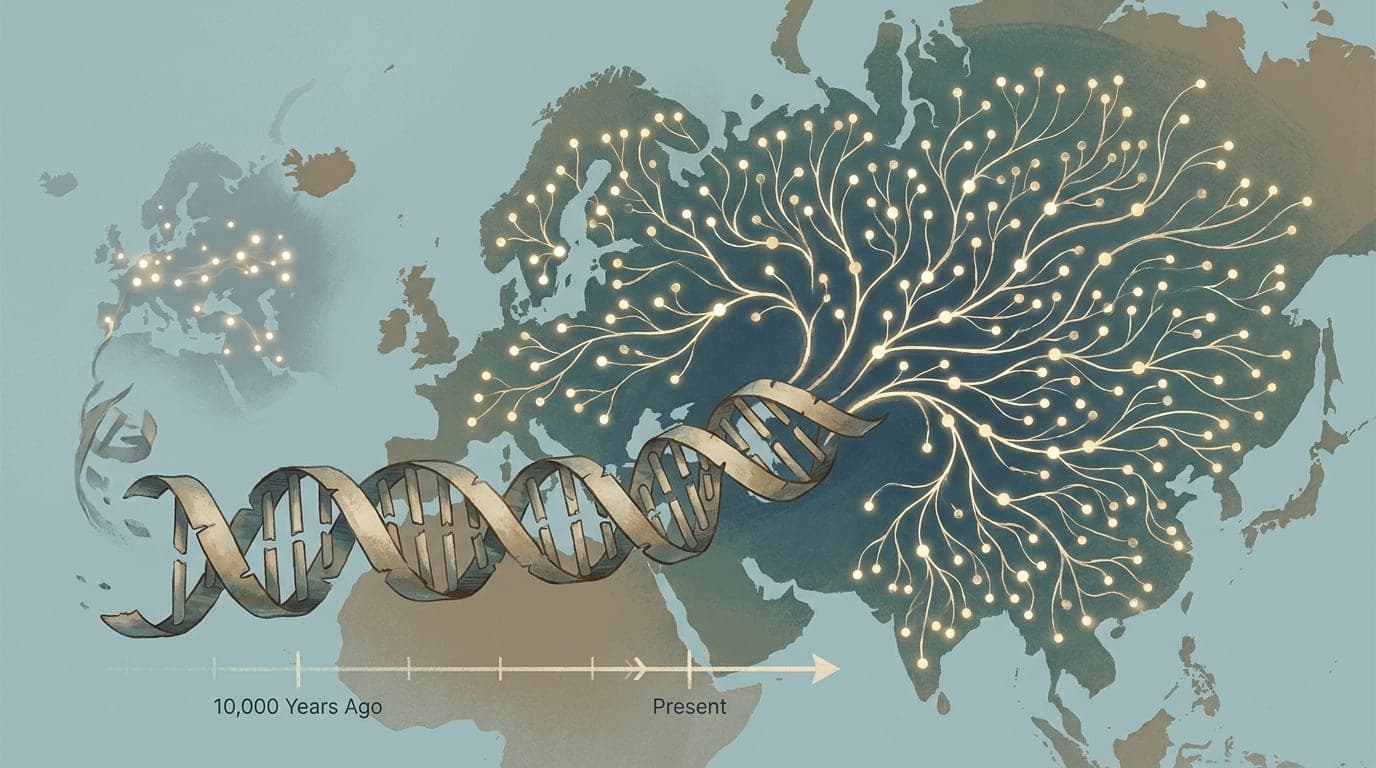
Seldom has a single scientific publication so fundamentally challenged prevailing assumptions about recent human evolution. A study published in Nature on April 15, 2026, has revealed that natural selection has shaped modern human genomes far more extensively than scientists previously believed. Led by Ali Akbari and a large team affiliated with Harvard Medical School, the research analyzed 15,836 ancient West Eurasian genomes, of which 10,016 were newly sequenced. This unprecedented dataset spans more than ten millennia of human genetic history.
What distinguishes this research from prior investigations is both its scale and its methodological innovation. Earlier studies had identified only approximately 21 instances of directional selection in the human genome. Directional selection occurs when a gene variant that confers a survival advantage rises steadily in frequency across a population. Using novel computational methods, the team identified 479 alleles that were strongly selected for or against in West Eurasian populations. Although directional selection accounted for merely two percent of all gene frequency changes, this still encompasses a substantial portion of human DNA.
A critical innovation was the development of analytical tools capable of isolating genuine adaptive signals from background noise. Distinguishing true directional selection from shifts caused by migration, population mixing, or random genetic drift has long posed a formidable challenge. The new computational framework tests for consistent, long-term trends in allele frequency change over time. As David Reich noted, this paper effectively doubles the size of the existing ancient human DNA literature.
Among the most compelling findings was that selection accelerated following humanity's transition from hunting and gathering to agriculture. The genetic data revealed specific evolutionary trends, including decreases in alleles linked to body fat and schizophrenia risk. Simultaneously, increases were observed in genetic variants associated with cognitive performance. However, the researchers issued an important caveat regarding the interpretation of these complex traits. Such traits are measured using standards derived from modern industrialized societies and may not accurately reflect ancient adaptive pressures.
The implications of this research extend well beyond academic genetics. More than sixty percent of the identified variants have documented links with present-day health conditions. Understanding why certain disease-associated alleles once provided survival benefits could yield valuable insights for contemporary medicine. Furthermore, the methods developed here can now be applied to ancient DNA datasets from other regions worldwide. Consequently, a far more comprehensive picture of global human adaptation may soon emerge from ongoing research.