
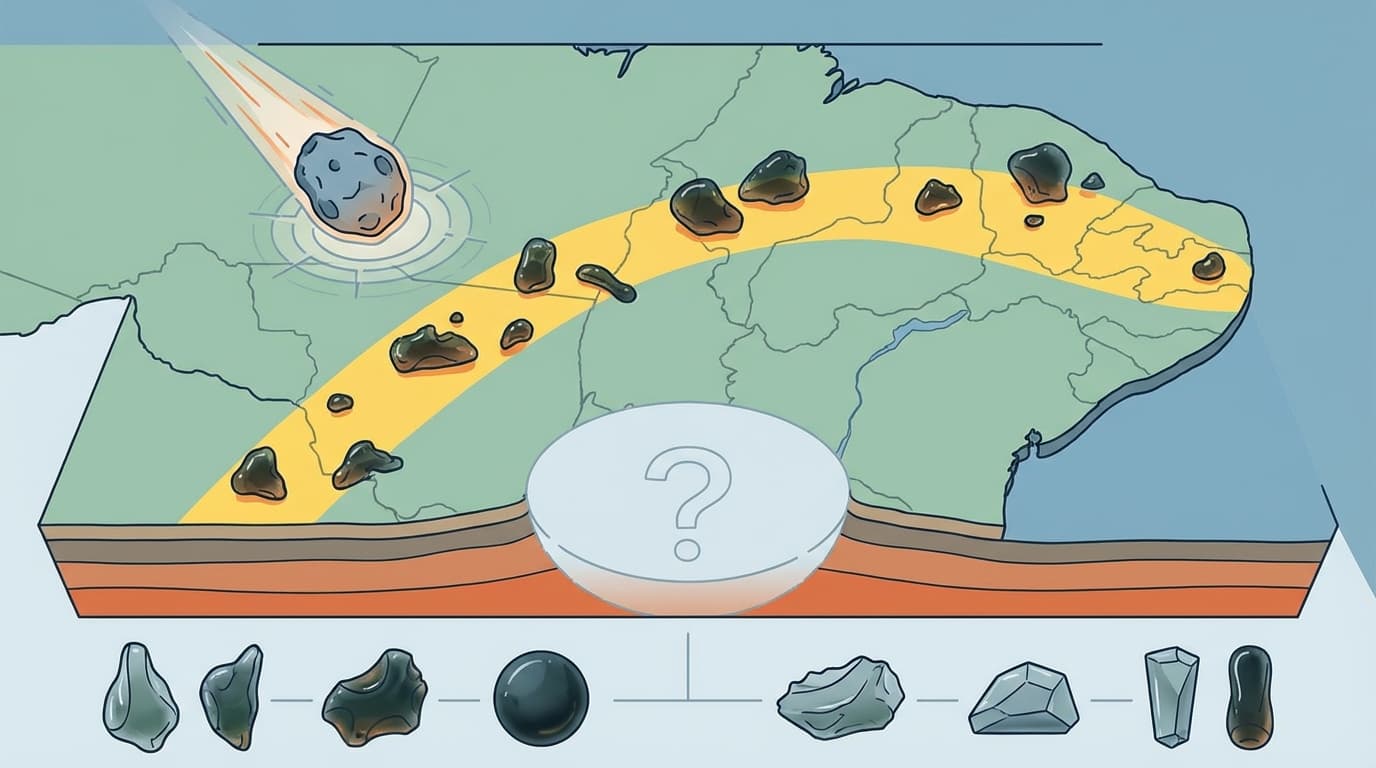
Scientists have confirmed a remarkable geological discovery in northeastern Brazil. An international research team, led by geologist Álvaro Penteado Crósta, identified hundreds of rare glass fragments. These fragments, known as tektites, were formed by an ancient asteroid impact. The collision, which had occurred approximately 6.3 million years ago, scattered molten rock across a vast area. This finding represents the first confirmed tektite field ever documented in South America.
Tektites are natural glass objects created when an extraterrestrial body strikes the Earth with tremendous force. The intense heat melts surface rocks, which are then ejected through the atmosphere. As the molten material cools rapidly during flight, it solidifies into glass before falling back down. The Brazilian specimens, named geraisites after the state of Minas Gerais, span over 900 kilometres. Researchers have collected more than 600 fragments, ranging from one gram to 85.4 grams each.
One of the most intriguing aspects of this discovery is the absence of a crater. Had the crater been preserved, scientists could have determined the asteroid's precise size and trajectory. Only half of the world's known tektite fields have confirmed craters linked to them. Erosion, sedimentation, and dense vegetation may have obscured the impact site over millions of years. Geochemical evidence suggests the asteroid struck the São Francisco craton, an ancient geological region.
This discovery significantly expands the global understanding of asteroid impacts on Earth. Previously, only five major tektite strewn fields had been recognised worldwide. The research team is now developing mathematical models to estimate the energy released by the collision. Future surveys using satellite imagery and geophysical methods could eventually reveal the hidden crater. If the crater were found, it would provide invaluable data about this powerful prehistoric event.