
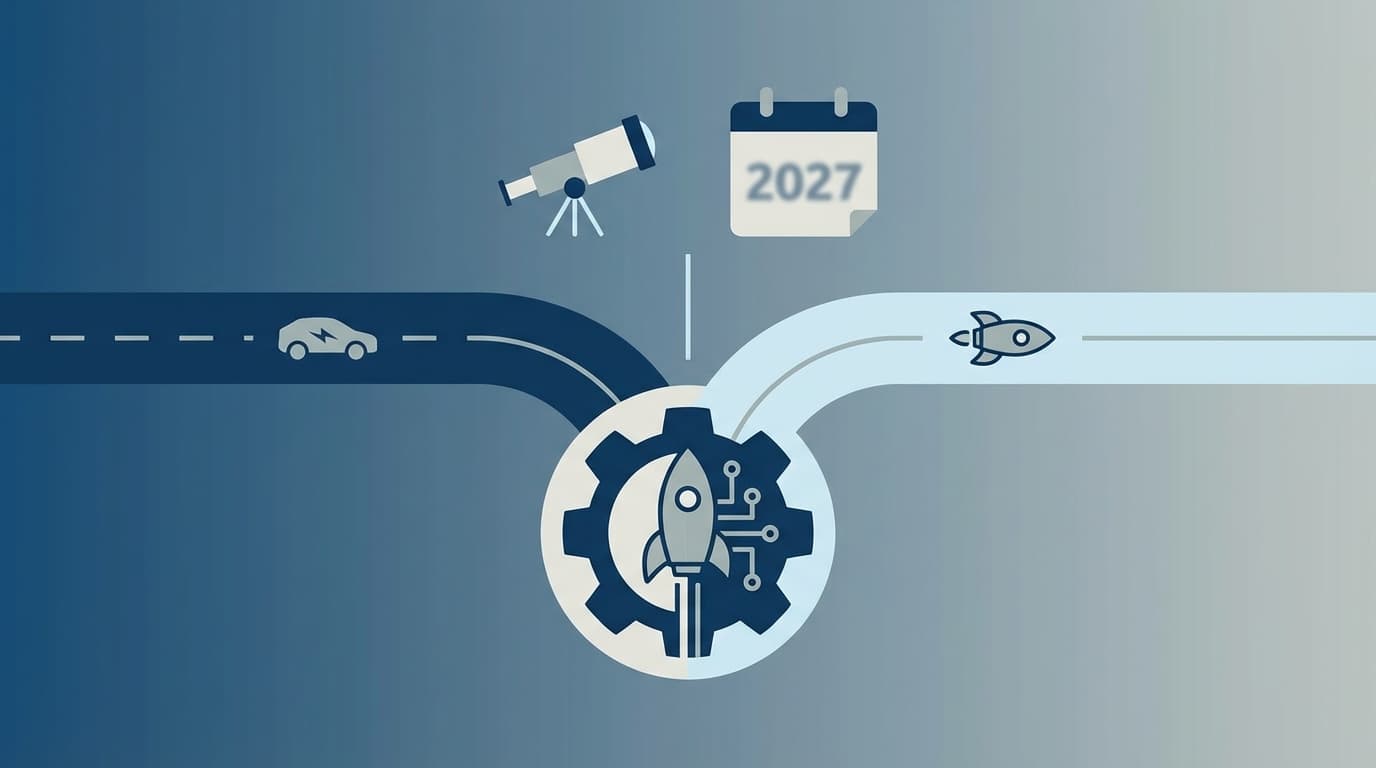
Seldom has a single Wall Street prediction generated such widespread debate across financial markets. Wedbush Securities analyst Dan Ives has reaffirmed his forecast that Tesla and SpaceX will merge by 2027. The prediction, outlined in a recent research note, describes the consolidation as a logical next step. It is fueled by deepening operational ties and shared artificial intelligence ambitions between the two firms.
Central to this thesis is the recently announced Terafab project in Austin, Texas. This joint chip manufacturing facility will serve both Tesla's autonomous vehicle operations and SpaceX's orbital infrastructure. Ives characterizes the Terafab as the critical first step toward full operational integration. Small-batch production of advanced AI chips is expected in late 2026, with volume output projected for 2027.
The merger prediction coincides with SpaceX's imminent initial public offering, which could value the company at approximately $1.75 trillion. SpaceX reportedly aims to raise around $75 billion, potentially making it the largest IPO in history. Following its February 2026 acquisition of xAI at a combined $1.25 trillion valuation, SpaceX has consolidated major AI assets. This strategic positioning strengthens the rationale for an eventual merger with Tesla.
Not all analysts share this bullish outlook, however. Investor Gary Black of The Future Fund has cautioned that a merger could dilute Tesla's stock value by twenty to twenty-five percent. Significant regulatory hurdles from the Federal Trade Commission and Department of Justice would also need to be overcome. Nonetheless, Ives maintains an Outperform rating on Tesla with a $600 price target, implying substantial upside.
Should this unprecedented consolidation materialize, the resulting conglomerate would span electric vehicles, robotics, satellite communications, and defense. Musk reportedly seeks to own roughly twenty-five percent of Tesla to steer its AI future effectively. The merger would grant Tesla direct access to SpaceX's orbital computing assets for training advanced neural networks. Whether regulators and shareholders ultimately approve such a transformative deal remains the paramount uncertainty.